
HARDWICK HALL, ARMS AND ARMOUR
Client: The National Trust
Location: Near Chesterfield, Derbyshire
We conserved the large collection of arms and armour at Hardwick Hall. The objective of this major project was to bring the entire armour collection at Hardwick to a state of conservation and display that would ensure its longevity in what is the far from ideal environment of the entrance hall, and prevent as far as possible deterioration from poor fixing/security and display. Although the individual pieces in the collection vary in actual quality and importance, as a whole it represents the largest single collection of arms and armour within the National Trust’s care. The condition of the arms and armour also varied and had been subject to many ad hoc treatments and care regimes over many years. Overall this had resulted in the collection being in a generally poor state, both visually and in terms of its stability. Much of the paint and wax finishes overlaid rust, which although not causing rapid deterioration would have continued to present an ongoing conservation problem. In addition, much of the display was poorly mounted and was potentially insecure as a result of weak fixings and broken stands. For full details of the conservation processes, please see below.
Civil War Armour:
Before conservation, the large collection of helmets, breastplates and backplates was heavily rusted both inside and out. Outward surfaces had a thin black paint finish but this had failed and pit corrosion had broken through across the whole surface of most objects. There was evidence of black lead on some suits beneath the paint. Inside surfaces appeared to have never been surface coated in any way; bare rust predominated across the whole collection. For display purposes and to consolidate loose components, at some time in the past holes had been drilled or punched through waists and shoulders on the armour and on the side of the helmets to attach loose ear flaps and visors.
Paint samples were taken from selected suits and analysed. The surface black paint was removed using paint remover. Care was taken not to remove underlying paint (possible original surface finishes) or to get paint remover on leather and textiles. Surfaces were white spirit washed to remove paint remover residue. Selected areas were cleaned with Acetone using swabs and brushes, particularly around rolled and folded edges. Loose rust was removed using Grade 0000 wire wool. Heavy rust pustules were removed with a scalpel when necessary. Inventory marks were reinstated, on a Paraloid B72 base, using a Uniball inventory marker, and then sealed with another layer of Paraloid. All surfaces inside and out were cold waxed; this was then heated with a warm air blower into the surface and then buffed when cold. A further two coats of wax were then applied and buffed. Loose components, earflaps, visors, tails etc previously wired in place were consolidated by using either small stainless steel bolts, where appropriate, or black polypropylene cable ties. Bolts were lacquered using shellac stained with black / brown, to dull their visual appearance. All armour marks discovered during cleaning were recorded. The stands were repaired, consolidated and contact points were then padded with inert foam strips.


Chain Mail Vest and Trousers and Chain Mail Jacket:
The chain mail had been damaged by having been nailed to the backboards with carpet tacks. There were holes in the mail that had been created by the point loading of the tacks. There was light rusting on some of the links. They were also very dusty and greasy. The mail was removed from the backboards and cleaned. The damaged link areas were reconfigured – where possible using original links. To improve the structural integrity, new links were used to pull together the fish scale plates which made up the back of the jacket and vest. The mail waz then hung using quarter inch bar steel hangers inside the suits to spread the load across the shoulders. These hangers were bolted to the backboard using black plastic-coated cable clips. All rear protrusions from the board were covered with inert foam pads. Prior to rehanging the mail was waxed thoroughly. The wax was warmed into the surface using a hot hair gun.


Collection of Rare Civil War Muskets, Flintlocks, Pistols and parts thereof:
The locks and barrels were heavily rusted and some parts were missing. The stocks were heavily woodwormed and broken where the worm had undermined the wood’s structural integrity. All the parts were dirty and dusty. Some of the guns were held together with red zip ties where the barrel hoops had disappeared. Where possible all the guns were dismantled. All the iron parts were de-rusted using hand picks and brushes or rust remover. Each part was then washed, dried and warm waxed then lightly buffed. The wooden stocks had already been treated for worm and no evidence of activity was found. To return the structural integrity to the wood, the worm holes were injected with PVA. The surface of the wood was lightly cleaned and then waxed.


Sword, Halberd and Partisan Displays:
A total of 47 swords, 6 halberds and 2 partisans were conserved. The swords are of polished steel and have ray skin and wire handles. The halberds and partisans are polished steel on wooden shafts with brass staff butts. Prior to conservation, the polished steel was either waxed or covered in Vaseline. The wire on the sword handles was loose and in some cases missing. The polished steel areas were generally bright but rust spotting and surface dirt were a problem. Due to the elaborate nature of the displays and overlapping blades, bimetallic corrosion was occurring at the overlap points. The halberds and partisans had nails in their shafts to act as supports in the display. We degreased, cleaned and polished all polished steel areas, removing rust spotting, then consolidated the wire on the ray skin handles of the swords. We removed the iron nails from the halberd and partisan shafts and replaced them with a non-ferrous equivalent (plastic sleeved). We polished the brass shaft butt ferrules. The collection was then re-hung using inert foam packing to isolate the components from each other. The wire fixings were replaced with polypropylene cable ties.
 After conservation
Lord Cavendish’s Ceremonial Armour:
Stirrups, Horse Bit, Spurs and Leather Powder Cases: Generally the pieces were in good condition. The silver-plated brass and polished brass were lightly tarnished and there was some polish residue found in the rebated areas. The stirrups, bit and spurs were cleaned, polished and relacquered. The metal insignia from the powder cases was removed before being cleaned, polished and relacquered.
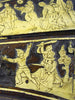
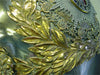
Back Plate, Breast Plate and Helmet: The lacquer on the breastplate and back plate was degrading and small rust spots are visible. Any polished steel and brass details are tarnished. The linings of the plates and helmet were found to be generally dusty and fragile. The linings of the helmet and armour were carefully removed where possible to enable cleaning. All the rust was gently removed from the surface of the steel which was then cleaned and polished. Brass details were polished and general dust and dirt was removed from the velvet, leather and braid. All the steel and brass was then degreased and lacquered.
 Before conservation - note polish residues
Three Cavalry Sabres: The sabres were found to be in generally good condition but there was some rust pitting on the scabbards and some dirt found in recesses. All the rust was carefully removed. All the dirt was removed. The pieces were then polished and wax was applied to the warmed steel surfaces.
Two Ceremonial Swords: On the first sword some rust spots were visible on the steel blade and handle. The detailing brass and silver were lightly tarnished. The ray-skin handle was generally dusty. Any rust spots were gently removed from the steel blade and the detailing. All the brass was polished, degreased and lacquered. Wax was applied to the warmed surface of the blade. The ray-skin handle was lightly dusted. Any silver detailing was lacquered. On the second sword the lacquer was degrading on the surface and some tarnishing of the bronze brass and plated elements was evident. The wire on the handle was loose. The old lacquer was removed and the surface cleaned and polished. The sword was then relacquered and wax was applied to the warm surface of the blade. The wire detailing of the handle was secured with a new pin.
 After conservation
Arms and Armour examples